

You let your cat out for a routine evening stroll, and they don’t come back. Hours pass. Then a full day. Your mind races through every worst-case scenario.
It’s one of the most gut-wrenching experiences a cat owner can go through.
But here’s something that might bring you comfort: cats are far more capable of finding their way home than most people realize. The question “Do cats find their way home” has a surprisingly fascinating answer rooted in biology, instinct, and a deep emotional connection to their space.
How Do Cats Find Their Way Home: The Science Explained
Cats aren’t just wandering aimlessly when they roam. They’re building an internal map of everything around them.
Researchers believe cats use a combination of magnetic sensitivity, scent memory, and spatial awareness to navigate. Some studies suggest that cats may have magnetite particles in their inner ears, similar to those found in migratory birds. This gives them a kind of biological compass.
In a well-known German study, cats placed in a maze consistently oriented themselves toward home, even from locations they had never been before. It wasn’t luck. It was instinct doing its job.
Scent: The Invisible Trail Back
Cats are heavily scent-driven animals. As they explore, they leave pheromone markers and absorb the smells of the environment around them. Over time, this creates a detailed sensory map of their territory.
Even after weeks away, a cat may retrace its scent trail through familiar landmarks and gradually find its way back to your door.
This is one of the reasons barn cats, despite roaming across large open properties every single night, consistently return to the same shelter. Their nose and memory work together like a GPS that never loses signal.
Spatial Memory and Routine
Cats are creatures of habit. They learn routes, recognize landmarks, and build a mental picture of their surroundings through repetition.
An indoor-outdoor cat that has spent years in the same neighborhood carries a rich mental map of every alley, fence, and familiar smell in a wide radius. That map doesn’t disappear when they get lost. It’s exactly what helps them come back.
Do Cats Find Their Way Home From Long Distances?
This is where things get genuinely astonishing.
There are documented animal stories of cats traveling over a hundred miles to return home. One of the most widely covered cases involved a cat named Holly who traveled nearly 200 miles across Florida over two months after being separated from her family during a road trip.
She arrived thin and exhausted, with worn paw pads. But she arrived.
Scientists found it difficult to fully explain. The combination of magnetic navigation, scent tracking, and sheer drive to return to familiar ground seemed to be the only plausible answer.
The Emotional Pull of Home
Beyond biology, there is something harder to measure: attachment.
Cats form real bonds with the spaces they live in and the people they share those spaces with. Home represents safety, warmth, and routine. When a cat is lost, that pull toward home doesn’t just switch off.
It’s one of those animal friendship story moments that reminds us how deeply connected animals are to the places and people they love.
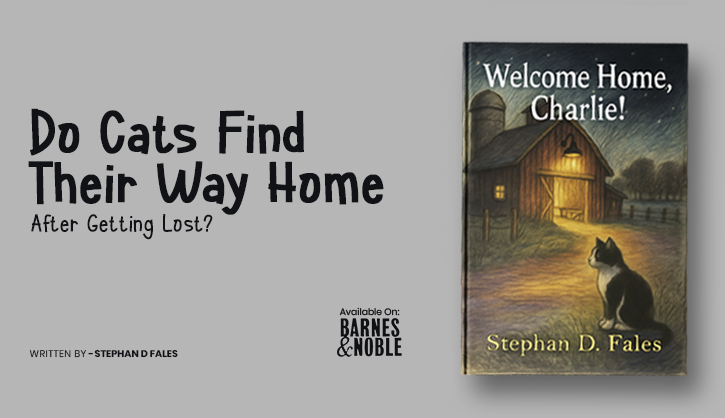
The children’s book Welcome Home, Charlie! by Stephan D. Fales captures this beautifully. It follows a cat navigating its way through uncertainty and hardship to return to where it belongs. It’s a quiet, moving story that resonates because it reflects something real about the bond between cats and home.
What Actually Happens When a Cat Gets Lost
Understanding cat behavior when lost can help you search smarter.
Most cats, especially indoor ones, don’t travel far when they first get out. They tend to hide nearby, often within a few blocks of home. Fear kicks in, and their instinct is to stay invisible rather than move.
Outdoor cats and barn cats behave differently. They’re more comfortable in open spaces and may cover a significant distance quickly. But even they often establish a temporary shelter close to home before orienting their way back.
Why Your Cat Might Be Hiding Rather Than Returning
A lost cat under stress reverts to survival mode. That means staying low, staying quiet, and staying still.
This is why many owners search for days without spotting a cat that is literally hiding twenty feet away. The cat isn’t ignoring you. It’s doing exactly what its instincts tell it to do.
Searching at dusk or dawn, leaving worn clothing outside, and placing a litter box near your door can all work with your cat’s instincts rather than against them.
Finding a Home for a Cat That Returns After Being Lost
When a lost cat does make it back, the reunion isn’t always smooth.
Returning cats are often dehydrated, underweight, and emotionally worn out. Finding a home routine that eases them back to normal takes patience.
Keep their environment calm. Stick to consistent feeding times. Let them lead the pace for reconnecting. Their emotional memory of home is still intact. Their body just needs time to recover.
A vet visit in the first day or two is always a good idea to check for injuries, parasites, or signs of dehydration they may have picked up along the way.
How to Give Your Cat the Best Chance of Coming Home
Preparation matters more than most owners realize.
Microchipping is the single most effective step you can take. It ensures that if someone finds your cat and brings them to a shelter or vet, you can be contacted immediately. A well-fitted collar with a clear ID tag adds another layer of protection.
GPS trackers designed for cats have also improved significantly. If your cat spends time outdoors, one of these can save you days of searching.
Building a strong territorial bond around your home also helps. Cats that are allowed to safely explore a defined area develop a richer internal map. That map becomes their guide home when something goes wrong.
Conclusion
Cats are not as fragile or as helpless as we sometimes imagine. The question of whether do cats find their way home doesn’t have a one-size-fits-all answer, but the evidence is clear: many do, and some do so under conditions that would seem impossible.
Home, for a cat, is more than a building. It is the smell of familiar air, the sound of known voices, the feeling of safety that only one place in the world provides.
When a cat fights its way back through miles of unfamiliar territory, it is not just following its nose. It is following something that feels, in every meaningful way, like love.
If that idea moves you, Welcome Home, Charlie! by Stephan D. Fales tells exactly that kind of story. It’s a gentle, honest reminder of what home means to the creatures who love us without condition.
Frequently Asked Questions
Q.1 Can cats really find their way home after being lost?
Yes, many cats do find their way home after being lost, sometimes after days or even weeks. Their ability to navigate relies on scent memory, spatial awareness, and possibly magnetic sensitivity. The longer a cat has lived in a home, the stronger its internal map of the surrounding area tends to be.
Q.2 How do cats find their way home across long distances?
When exploring how do cats find their way home over many miles, researchers point to a combination of magnetoreception, scent tracking, and spatial memory. These systems work together to help cats orient themselves even in unfamiliar territory. It is one of the most remarkable navigation abilities found in domestic animals.
Q.3 Are outdoor or barn cats better at finding their way home?
Generally, yes. Barn cats and outdoor cats spend more time navigating large territories, which means they develop stronger spatial awareness and more detailed scent maps. Indoor cats can still return home, but are more likely to hide close by rather than travel far.
Q.4 What should I do immediately after my cat goes missing?
Start searching nearby hiding spots as soon as possible, especially at dawn and dusk when cats are more active. Leave worn clothing and a litter box outside your home to attract your cat back using familiar scents. Notify local shelters and post on community platforms with a clear photo.
Q.5 Does microchipping really help cats get home safely?
Microchipping does not help a cat navigate, but it dramatically increases the chance of a reunion if your cat is found and brought to a vet or shelter. When combined with a GPS collar for outdoor cats, it is the most reliable safety net available for any cat that spends time outside.