

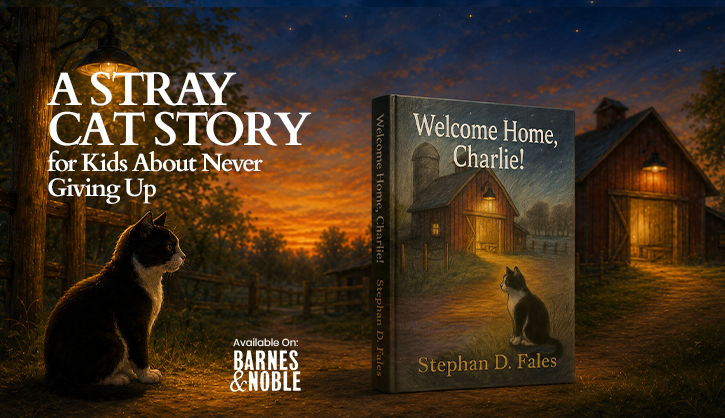
Some stories stay with children long after the last page is turned. Not because they are loud or dramatic, but because they are honest. They show a character who falls down, feels afraid, and gets back up anyway. Welcome Home, Charlie! by Stephan D. Fales is exactly that kind of story. It is a stray cat story for kids that quietly teaches one of life’s most important lessons: no matter how hard things get, you do not have to give up.
Who Is Charlie?
Charlie is not a superhero. He is not magical. He is a small stray cat born into a world that does not make things easy for him.
From his very first days, Charlie faces loss. His siblings disappear one by one. His hiding spot floods. Food is hard to find. The weather turns against him. Predators follow him in the dark. There is no one to call for help and no map showing him where to go.
What Charlie does have is something that cannot be taken away: the will to keep moving.
That is what makes this stray cat story for kids so quietly powerful. Charlie never gives up, not because he is fearless, but because stopping is simply not something he allows himself to do. Every time the ground falls away beneath him, he finds the next small step forward.
Why “Never Giving Up” Is Hard and Why Charlie Shows It Honestly
Many stories for children tell kids to be brave. They show characters charging forward without hesitation, never looking back, never doubting themselves.
Charlie’s story is different.
He is afraid. He hesitates. There are moments where exhaustion pulls at him and the darkness feels too heavy. When he is attacked and left badly wounded, he does not spring back immediately. He crawls. He drags himself toward something that might be shelter. He collapses into the straw of a stranger’s barn and surrenders to unconsciousness.
That is not weakness. That is resilience in its most honest form.
Resilience does not mean never feeling broken. It means continuing even when broken feels like all you are. For young readers, seeing Charlie struggle in real and believable ways makes his perseverance meaningful. They are not watching a character who finds strength easy. They are watching a character who finds strength necessary.
The Moments That Define His Grit
Throughout the story, there are several moments where Charlie could stop but chooses not to.
When his hideout floods and every familiar thing is gone, he does not freeze. He looks at the horizon, feels something pulling him forward, and walks toward it.
When he is hurt and bleeding, he does not wait to be found. He moves toward the sound of the barn, toward the faint warmth of something that might mean safety.
When Charlene is hurt and confused by his choices later in the story, he does not disappear or shut down. He tries to bridge the distance between them, even when he does not fully understand how.
Each of these moments is small. None of them are cinematic. But that is precisely what makes them feel real to young readers. Grit in everyday life does not usually look like a grand gesture. It looks like taking one more step when stopping seems easier.
You can explore the 7 important life lessons Charlie teaches young readers in detail.
What Kids Learn From Charlie’s Perseverance
Children face their own versions of Charlie’s challenges every single day. A new school where no one knows their name. A friendship that breaks without explanation. A moment of failure that feels final.
A stray cat story for kids like this one gives children something invisible but deeply valuable: a model for how to keep going.
When a child reads about Charlie moving through the dark toward the barn, something resonates. They may not be able to name it immediately. But somewhere inside, they store the image. A small creature who did not stop. A character who chose the next step over standing still.
That image becomes a quiet resource. Something to return to when their own ground feels unsteady.
Perseverance and the People Who Help Along the Way
One of the most honest things about this stray cat story for kids is that it does not pretend perseverance means going it alone.
Charlie keeps moving on his own. But when Charlene finds him and offers care, he allows himself to receive it. That too is a form of strength. Knowing when to accept help is part of never giving up. It means staying open even when every past experience has taught you to stay closed.
The relationship between Charlie and Charlene is not about rescue in the traditional sense. Charlene does not swoop in and fix everything. She creates a space where Charlie can rest and heal. And Charlie, despite every reason to refuse trust, lets himself stay.
That willingness to remain open, even after pain, is perhaps the deepest lesson the story offers. Perseverance is not only about pushing through. It is about staying soft enough to receive what the world eventually offers.
Why This Story Belongs on Every Child’s Shelf
Welcome Home, Charlie! is the kind of stray cat story for kids that grows with its reader. A younger child will follow the adventure and feel the warmth of Charlie’s eventual safety. An older child will begin to see what the journey actually cost, and what it ultimately gave back.
Either way, the lesson lands: you do not have to be perfect, fearless, or certain to keep going. You just have to take the next step. Then the one after that.
In a world that often rushes children past difficulty or shields them from the reality of struggle, this story offers something different. It shows them a character who struggled and survived. Not because he was exceptional, but because he refused to stop.
That is a lesson worth reading. And worth remembering.
Browse all available formats and editions of Welcome Home, Charlie! or grab your copy directly from the shop today.
Frequently Asked Questions
Q1: What is this stray cat story for kids about?
It follows Charlie, a young stray cat who faces danger, injury, and loss but keeps moving forward until he finds safety, friendship, and a place where he truly belongs.
Q2: What age group is this stray cat story for kids suited to?
It works beautifully for children aged 8 to 12, either as an independent read or a classroom read-aloud.
Q3: What lesson does this stray cat story for kids teach?
At its heart, it teaches perseverance. Charlie keeps going even when everything feels impossible, showing children that courage is not the absence of fear but the decision to continue anyway.
Q4: Is this suitable for sensitive children?
Yes. While Charlie faces real challenges, the story handles difficulty with warmth and care. It is honest without being overwhelming.
Q5: Where can I find this stray cat story for kids?
Welcome Home, Charlie! is available on Barnes and Noble and at authorstephanfales.com/shop/.